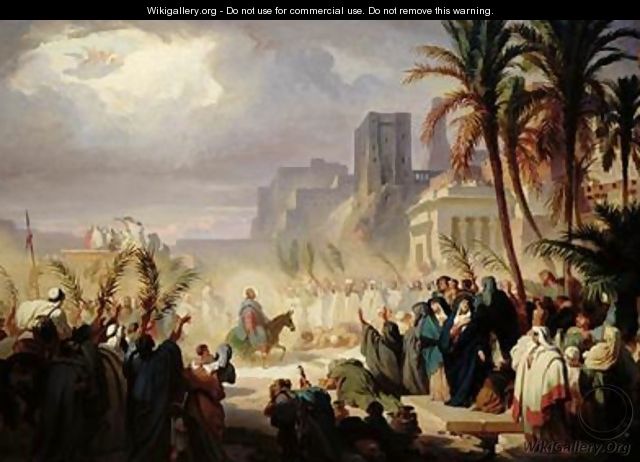
Zec 9:9 Rejoice greatly, O daughter of Zion; shout, O daughter of Jerusalem: behold, thy King cometh unto thee: he is just, and having salvation; lowly, and riding upon an ass, and upon a colt the foal of an ass.
–
In verse 10, the prelude is given to us when the Lord through the prophet declares, “Now I see with my eyes.”
Verse 9 is particularly important for this passage as it is referenced twice in the New Testament – Mat 21:5 & Joh 12:15 – as proof of Jesus’ fulfilling the prophecy. This fulfillment gives us a marker for what is being referred to here.
What is of particular interest in this passage is the intermingling of literal and interpretative terms. What I mean by this is that as we move forward, there are words which are used which are not to be taken literally, while other parts of the prophecy are very literal. We will enter into an example very soon.
“What?“
“Rejoice greatly!”
“Who?“
“the daughter of Zion!”
“What?“
Shout!
“Who?“
“the daughter of Jerusalem
When we compare with the fulfillment of this prophecy, we will find that the ‘Whats’ are literal. The people were literally rejoice, and shouting Hosanna. They were putting their clothes on the ground, hacking off palm tree branches to line His route. They were rolling out the red carpet for Him.
However, we find that the ‘Whos’ are figurative. The daughter of Zion/Jerusalem (both names reference the same city, Zion meaning ‘parched place/monument’ while Jerusalem means ‘teaching of peace/founded peaceful’) Matthew Poole notes in his commentary on Psalms 9:14 that daughter could be a reference to “the people who live in, or belong to, or meet together for civil and religious matters in Zion. For cities are as it were mothers to their people, giving them birth and breeding, and therefore the people are commonly called their daughters.” I think this reasoning is quite sound, though I have not done the background study work and will have to revisit it some time. It does mesh very nicely with what we see happen in the prophecy. The people of Jerusalem were rejoicing and shouting on that day when Jesus rode into Jerusalem.
As a rule of thumb, when reading Scripture, we start with a literal reading before we go to the figurative. I wonder how many Jews thought of this passage on that fateful day that Jesus made his way into Jerusalem. It should have been a monumental marker of His being the Messiah. Sadly, we know many missed it because it was not long later He would be condemned by the mob.
Let’s ask a different question that this verse answers:
“Why?“
“Thy King cometh unto thee”
There was something special about this King. This king was the prophesied king who would sit on the throne of David. The king whose kingdom would be forever. Sprinkled throughout the prophets were glimpses of what was to come, and the people had it all at their fingertips if they were watching.
When Jesus comes the second time, it will be much more so. There are no excuses for us to miss His coming. While there is much that is hard to understand, there are certain signs that unmistakable if we hold the Word of God in truth and sincerity. May we keep our lights burning bright.
There is more attached to the question of why. Not only is the long-awaited King coming, but there is a description given of Him, including something very specific.
He is just
Quite literally, He is righteous. Look no further than at His trial before the priests, when they could find nothing with which to accuse Him. For all the controversy that surrounded Him, they could make nothing stick save to twist His words out of context. In the broad scope of Scripture, we hear this phrase: All have sinned and fallen short. Yeah, all have sinned, but this ONE. He is just. He alone can we fully, absolutely declare righteous.
He has salvation
Indeed, the very name of the Messiah would mean ‘Jehovah is Salvation’.
The word used for salvation here means to ‘open, wide, free’. That would be exactly what He accomplished when He took the keys of death and hell. No longer would the souls of men be bound.
The idea of freedom/salvation will be echoed again in Zec 9 in verse 11. In this verse is the idea of the Messiah making a covenant with blood. We will cover it in more detail soon.
When we look at other places this word is used and how it is interpreted into English, there are places such as Judges 3:15 where the words ‘a deliverer’ is used. I think this fits beautifully. If one gets the chance, a look in a concordance at all the other places the word is used and how we read it in English will give a wonderful expansion on what the Lord is telling His people the Messiah would bring.
He is depressed
The word used here for lowly means ‘depressed/afflicted’. I actually like that word more for I believe it highlights better what happened to the Christ. Consider the idea of this word when compared with Isaiah 53:3, where He is called a man of sorrows, despised, rejected, not esteemed. Lowly doesn’t tell the story well enough. He was depressed for you and me. The burden of His task, the rejection of His own would bring Him low, but He went through all the same.
He is riding upon an ass, and upon a colt the foal of an ass
This little detail here is where reading and taking the Word of God literally is so important. While the other descriptions of the Messiah were about his character and to some extent could be argued, this detail is not. If we read this literally first, it makes sense. It tells us that the Messiah will come to Jerusalem riding on a male ass – specifically, a young male ass. Now one might have left this as something they were not sure of, but on that day, when they saw Jesus riding in on a young ass, there should have been no doubt left that this was the King.
As a side note, there are three different words for asses used here. The first is masculine for the ass. The second is a young male ass (foal). The third is feminine for the ass. The different words used are illustrated particularly well in the Young’s Literal Translation which is at the end of this exposition.
As we now wait and look forward to the Second Advent, there are many things that we may find hard to understand, or unsure. That’s why it’s all the more important to study, and keep it all in mind, without being too set on our opinions, but simply knowing what the Scripture says, because there will be clear signs, that when they happen, will remove all doubt as to the fulfillment of Scripture. Let us speak where the Word speaks, and keep silence where it keeps silence.
May it be our prayer every day that our eyes may see the signs and our ears hear the Lord’s voice.
I love looking into the original words, their meaning, and ‘simplifying’ the text in some passages. I think this verse is one place where you could re-phrase it (part of the idea here is that when you learn something well, you can explain it in your own words, not just regurgitate) Here is what I believe is an accurate re-phrasing of the verse. Certain words I think get the idea across more forcefully in our day for what the original text is conveying, whilst some changes are simply with the figurative language to literal. It is by no means authoritative, simply something I enjoy doing to test/enhance my understanding:
Rejoice exceedingly, O people of Zion! Shout, O people of Jerusalem! Look, your King is coming to thee! He is righteous, a deliverer, afflicted, and riding on an ass, even a colt of the she-ass.
As we come to ever closer to the Second Advent, may we find the grace and strength needed in our times of trouble so that we too may look in expectation and exhilaration when we see Him coming in the clouds of glory!
Zechariah 9:9 Young’s Literal Translation
Rejoice exceedingly, O daughter of Zion, Shout, O daughter of Jerusalem, Lo, thy King doth come to thee, Righteous — and saved is He, Afflicted — and riding on an ass, And on a colt — a son of she-asses.
*Image from https://www.wikigallery.org/wiki/painting_257246/Felix-Louis-Leullier/The-Entry-of-Christ-into-Jerusalem. Used by permission
 Talking Bible
Leave a comment