Before Ephraim and Benjamin and Manasseh stir up thy strength, and come and save us.
It was many years ago that I first pondered this verse. I happened to ask the question of why. Why are Ephraim, Benjamin and Manasseh mentioned in particular? What was so special about these tribes? I read through all the commentaries I had on hand at the time. There were a small handful of them that were able to pinpoint the answer, while many got caught up in answers that were wildly off the mark.
These three tribes are mentioned together specifically in one other book in the Bible: Numbers.
In Numbers 2 we find the Lord instructing Moses and Aaron on how the Israelites were to arrange themselves as tribes when camping and in what order they were to march. In verses 18-24 you’ll find Ephraim, Benjamin, and Manasseh mentioned. They all camped on the west side of the Tabernacle with Ephraim being the leading tribe (in verse 24 it is referred to as the camp of Ephraim). Here’s the critical part for understanding what the Psalmist is praying in Psalms 80:2: when they marched, Ephraim, Benjamin, & Manasseh would march in the third rank, directly behind the Levites who were bearing the disassembled Tabernacle.
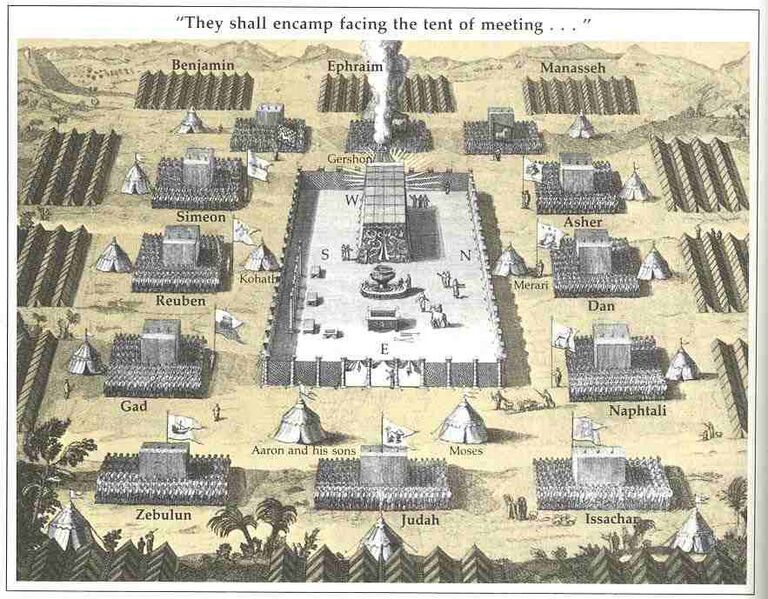
The Psalmist is calling upon God to move in front of them in His glory and power as He did in the days of old. This idea fits in line with the previous verse acknowledging that the Lord is leading Joseph like a flock. Moreover, when one considers Numbers 9:15-23, we find the glory of God rested upon the Tabernacle in the form of a cloud, indicating to the people that they were to stay in that location, and when it was time for them to pack their bags, it would ascend and go before them to lead the way (see Num 14:14, Ps 78:14). Thus, the Tabernacle was very much seen as the resting place of the awesome power of God which guided and protected the people throughout their wilderness journey. Indeed, one may perhaps understand all the more the people’s mindset when they called for the Ark of the Covenant in 1 Samuel when they were fighting against the Philistines.
Thus, I believe it can be illustrated very clearly that the reason for the three tribes mentioned in Ps 80:2 is because they marched directly behind the Tabernacle, and as such, were the most protected. The glory of God was directly in front of them.
If we are to read the verse in this context, it then makes all the more sense when the request is made to ‘stir up thy strength and save us!’
The word used for ‘stir up’ means literally, wake. It brings comparisons with passages such as Ps 78:65 and Isa 51:9. There are the undertones of Messianic prophecy in these passages, and indeed, we shall see later in this chapter that there is a reference to the Messiah – the man of the right hand (Ps 80:17, Isa 52:10).
The messianic tone of this prayer becomes even more apparent with the final words – come and save us. In the Young’s Literal Translation it reads, ‘Wake up Thy might and come for our salvation’. Messianic this prayer is for it is only through Jesus Christ that the people would truly be saved from their sins. It is fit, therefore, to see in this prayer a yearning and calling for the Messiah to come.
I close this short verse, yet one of my favorite gems in the Psalms by re-phrasing the verse:
‘As You were before Ephraim, Benjamin, and Manasseh in the wilderness, a cloud by day and fire by night, rouse up your power and bring salvation!’
O that we would have the same recognition in our hearts and minds that there is no salvation if God doesn’t bring it. All we can do is call back to the times when God moved mightily and pray, O God, move again or we perish. There is no salvation unless You act.
Notes:
– The Psalmist has already sorted his heart out, therefore it is fitting for him to call to God as he does. He has confronted his shortcomings, and finding himself unable to save himself, he now calls to the only One who can and is waiting for Him to act. I believe it’s important to recognize this as to call for God to act when one continues doing things their own way in rebellion and sin will not bring life or salvation
– A verse that came to mind while meditating on this passage was Romans 10:13-15, in particular, How shall they hear without a preacher? How shall they preach except they be sent? If God doesn’t send a preacher, there is no hope of salvation. If God doesn’t act, there is no hope
 Talking Bible

Leave a comment